Every home care recruiter has seen it: a good applicant applies on Indeed, gets a message or a booking link, and then goes quiet. By the time the office calls back, they have taken another job or stopped answering. This guide looks at where that drop-off happens and what closes the gap, using two real offices as examples. It is written by Care Hero, which builds AI phone screening for home care agencies.
Where do caregiver applicants drop off?
Most applicants are lost in the gap between applying and the first interview, before your team has had a real conversation with them.
A typical caregiver hiring funnel has four handoffs, and each one is a chance to lose someone:
- Apply to first contact. How long until the applicant hears from you.
- First contact to first-round interview. How long until the applicant actually answers your screening questions. This is usually the longest wait.
- First round to in-person interview. Whether qualified applicants show up. See how to reduce caregiver interview no-shows.
- Offer to first shift. Whether new hires start and stay. See the complete guide to caregiver retention.
Why do caregiver applicants drop off before the interview?
Because the interview is not available when they are. Caregiver applicants are often working shifts, and many apply to several agencies the same day.
- The wait is too long. A slot days away gives the applicant time to accept another offer.
- Phone tag. Recruiters call during office hours, when many caregivers are with a client and cannot pick up.
- Too many steps. A link to a form, then a link to a calendar, then a call: each step loses some applicants.
- Applications come in at night. Evening and weekend applicants wait until the next business day for anything to happen.
For more on the first two, read why caregiver applicants stop responding.
How fast should you get a caregiver applicant to an interview?
Within the hour of applying, while they are still looking at their phone. Two offices show what that looks like in practice.
Integrity In-Home Care, Portland, OR
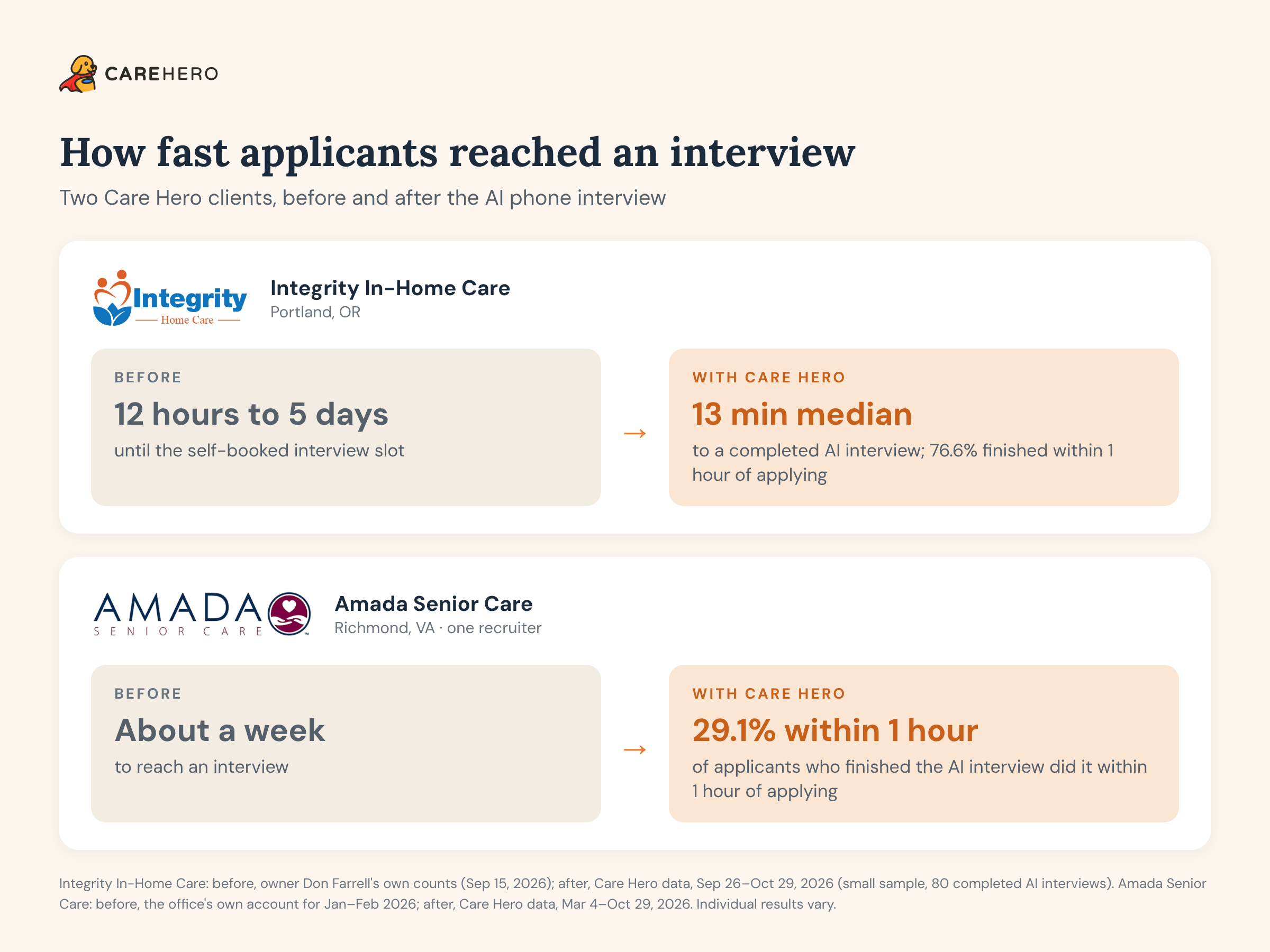
Before Care Hero, applicants booked their own interview slots anywhere from 12 hours to 5 days out (owner Don Farrell's own counts, Sep 15, 2026). With Care Hero, applicants get a message within minutes and call in to an AI phone interview. From September 26 to October 29, 2026, 76.6% of completed AI interviews were finished within 1 hour of applying, and the median was 13 minutes from applying to a completed AI interview. That is 80 phone interviews completed by the AI, a small sample, so we will keep watching it.
Week one at IntegrityThe interview calendar was full in the first week. Don switched Indeed ads off for two days because the slots had run out, something that had never happened before.
Amada Senior Care, Richmond, VA

Amada hires with one recruiter. Before Care Hero, it took about a week to get an applicant to an interview, and the office completed 22 phone interviews a month (the office's own counts, Jan–Feb 2026). Since going live in March 2026, the office has averaged 69 completed AI interviews a month: 550 AI phone interviews from 1,145 applicants, with the same one recruiter (Care Hero data, Mar 4 to Oct 29, 2026). 29.1% of the applicants who finished the AI interview did it within 1 hour of applying.
“I would give Care Hero a 2000 out of 10. It is wonderful. They apply on Indeed. I give them the number, and they call... It gave me extra space to do other things.”
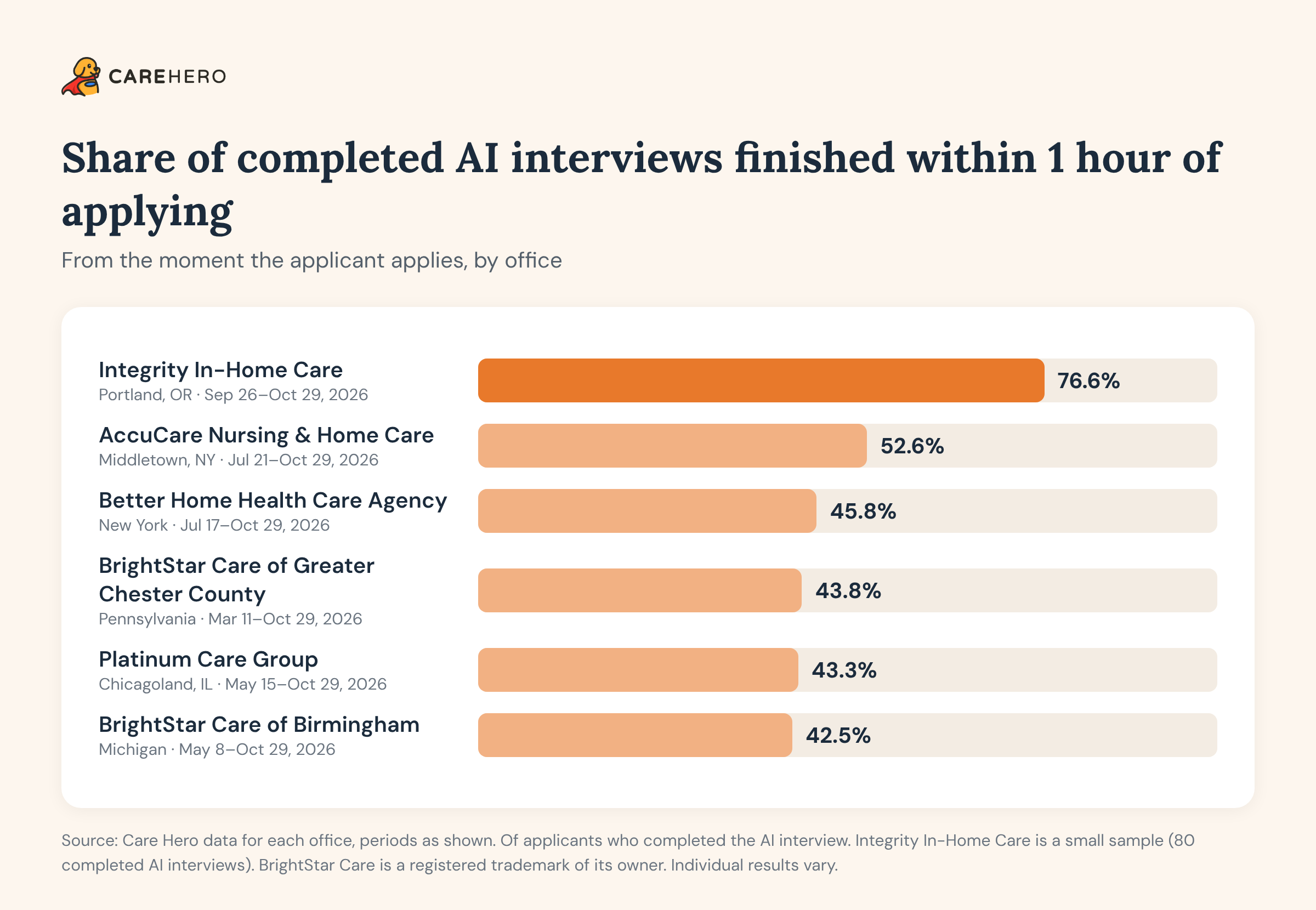
Integrity is not the only office where many interviews happen fast. Across six offices using Care Hero, between 42.5% and 76.6% of completed AI interviews were finished within an hour of applying:
How do you keep applicants who apply after hours?
Let them start the first-round interview right away, at any hour, instead of waiting for the office to open the next morning.
With Care Hero, the applicant gets a message within minutes and calls in to the AI phone interview when it suits them, 24/7. At Integrity In-Home Care, 41.3% of AI interviews happened in the evening or on weekends (Sep 26 to Oct 29, 2026). At Amada Senior Care, it was 26.2% (Mar 4 to Oct 29, 2026). Those are applicants who would otherwise have waited until the next business day. Your recruiter reviews the scored results in the morning and invites the best candidates in.
How do you measure applicant drop-off at your agency?
Count applicants at each step every week, and track how long the first gap takes. A few simple numbers are enough:
- Applicants this week.
- Completed first-round interviews this week, and the share of applicants that is.
- Time from applying to a completed first-round interview (the median), and the share done within 1 hour.
- Share of first-round interviews done after hours, to see how many applicants your office hours would miss.
- In-person interviews scheduled and attended, to spot no-shows.
- Hires and first shifts worked.
Compare the same weeks before and after any change you make. If completed first-round interviews go up while applicants stay flat, you are losing fewer people in the gap.
Integrity In-Home Care: before, owner Don Farrell's own counts (Sep 15, 2026); AI interviews, after-hours share and time to interview, Care Hero data, Sep 26 to Oct 29, 2026; small sample. Amada Senior Care: before, the office's own counts for Jan–Feb 2026; AI interviews and after-hours share, Care Hero data, Mar 4 to Oct 29, 2026. After hours = before 8 a.m., from 4 p.m. or weekends, local time. Individual results vary.