Every caregiver who leaves in the first few shifts leaves an empty shift behind and sends the recruiter back to the start. For many agencies, early turnover quietly costs more than a slow week of hiring. This guide covers what early turnover is, why new caregivers leave, what helps, and how one BrightStar Care office tracked it. It is written by Care Hero, which builds AI phone screening for home care agencies. Care Hero was founded by Jamie Gong, who has worked as a caregiver and knows how much a fast, respectful hiring process matters to caregivers and owners alike.
What counts as early caregiver turnover?
Early turnover is the share of new hires who leave soon after starting. Pick one clear definition and use it every month.
The BrightStar Care office in this guide defines it as the share of new hires and rehires who left before completing their first two shifts. Another agency might use the first 30 or 90 days. What matters is that you choose a definition, apply it the same way each month, and compare like with like.
How can home care agencies reduce early caregiver turnover?
Start by hiring for fit. Early departures often trace back to a mismatch between what the caregiver expected and what the job turned out to be.
- Check the basics early. Availability, service area, transportation, and experience are easier to confirm in the first conversation than after the caregiver has been scheduled.
- Use your own criteria. Decide what a good match looks like for your agency and screen every applicant the same way. Care Hero asks the questions you set and scores the answers against your rubric.
- Be honest about the job. Describe the schedule, the clients, and the work plainly. Caregivers who know what to expect are less likely to be surprised.
- Move quickly and respectfully. A fast, friendly first call tells a caregiver how the agency will treat them as an employee.
- Welcome them personally. A call or visit from a real person before the first shift matters more than any form.
- Check in after the first shifts. A short conversation after the first one or two shifts catches problems early.
These are practices, not guarantees. Which ones matter most will depend on your office and your caregivers.
Why do new caregivers leave early?
Common reasons include a mismatch in schedule or location, unclear expectations, and a first experience that felt rushed or impersonal.
- The shifts offered did not match the hours the caregiver wanted.
- The assignment was farther from home than they expected.
- The work was different from what they pictured.
- The hiring process felt slow, then rushed, and nobody checked in afterward.
These are common patterns in home care, not statistics. Ask caregivers who leave early why, and write down what you hear.
What this looked like at one BrightStar Care office

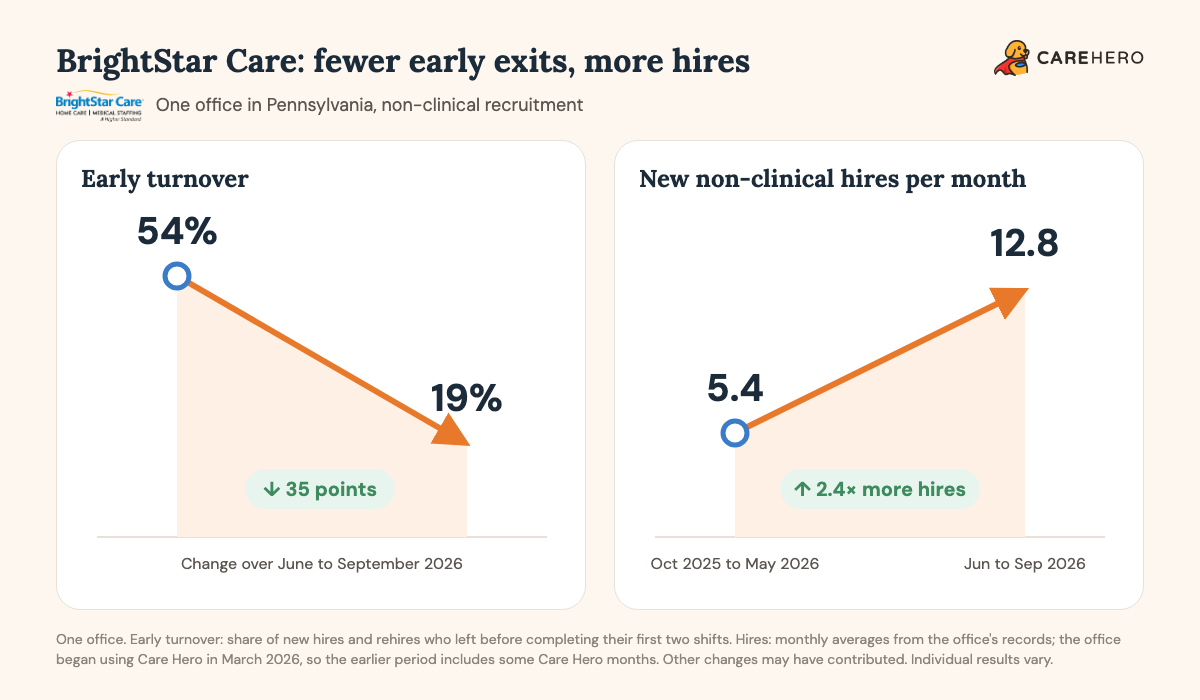
BrightStar Care of Greater Chester County, Pennsylvania, hires non-clinical caregivers. Between June and September 2026, the office tracked early turnover: new hires and rehires who left before completing their first two shifts. The office began using Care Hero in March 2026. Over the same period:
“A great improvement for our non-clinical recruitment over the last 4 months!”
Results from one BrightStar Care franchise office, non-clinical recruitment. Early turnover: share of new hires and rehires who left before completing their first 2 shifts, June to September 2026. New hires: monthly average June to September 2026 vs. October 2025 to May 2026, from the office's records; the office began using Care Hero in March 2026, so the earlier period includes some Care Hero months. This is one office, and other changes may have contributed. Individual results vary. BrightStar Care is a registered trademark of its owner. Read the full story.
How should an agency measure early turnover?
Count the new hires who leave within your chosen window, divide by the new hires in that period, and track it monthly.
- Use one definition, such as leaving before the first two shifts or within 30 days.
- Include rehires if you treat them as new starts, and say so.
- Watch the number of people behind the percentage. A small group can swing the rate a lot.
- Record the reason each caregiver gives for leaving.