A missed interview costs a recruiter more than the empty slot. The prep is wasted, the applicant may already have taken another job, and the search starts over. For agencies with one or two recruiters, no-shows are one of the quietest drains on hiring time. This guide is written by Care Hero, which builds AI phone screening for home care agencies, and it uses one real office as an example. Care Hero was founded by Jamie Gong, who has worked as a caregiver and knows how much a fast, respectful hiring process matters to caregivers and owners alike.
Why do caregiver applicants miss interviews?
Most no-shows come from delay and distance: too much time between applying and the interview, and too little connection to the agency in between.
These are common causes in home care hiring:
- A long wait for the first call. Caregivers often apply to several agencies in one sitting. By the time your office calls, they may have moved on.
- Interviews booked far out. The longer the gap between the screen and the interview, the more likely life gets in the way.
- Contact only during office hours. Many applicants are free in the evening or on weekends, and nobody is there to answer.
- Unclear expectations. If the applicant does not know what the interview is, how long it takes, or who they will meet, it is easy to skip.
- No human moment before the interview. A voice, a name, and a friendly first conversation make the interview feel like a real commitment.
These are patterns, not statistics. Your own numbers will tell you which one matters most in your office.
What helps reduce caregiver interview no-shows?
Shorten the time to first contact, schedule the interview during that first conversation, and confirm it clearly. Then keep your recruiter free to follow up.
- Call quickly, at any hour. Reaching an applicant while they are still thinking about your job is one of the biggest levers you control.
- Book the interview in the same conversation. A time chosen by the applicant is more likely to be kept than one sent later.
- Keep the gap short. Offer the earliest slot that works for the applicant, not the earliest slot that works for the office. With Care Hero's interview scheduling, an agency can set a phone-interview score, and applicants who reach it can book their own interview right from their phone.
- Set expectations. Say what the interview covers, how long it takes, and who the applicant will meet.
- Send reminders. A text before the interview, and a nudge to finish a phone interview that was started but not completed, bring back applicants who got busy. Care Hero sends an SMS reminder before the interview and reminds applicants to complete their phone interview if they have not.
- Make rescheduling easy. An applicant who can move the interview in one step is less likely to simply disappear.
- Screen on your own criteria first. When applicants who clearly do not fit are filtered before the calendar, the slots go to people who are a real match and more likely to attend.
How should an agency measure interview no-shows?
Count the interviews that were scheduled, count the ones where the candidate did not show, and track the share by month.
A few habits keep the number honest:
- Use the same definition every month: scheduled interviews that were not attended, divided by interviews scheduled.
- Record the time between application and the first contact, and between the screen and the interview.
- Set a baseline before you change anything, such as a monthly average over several months, so you can compare like with like.
- Change one thing at a time when you can, and write down the date.
What this looked like at one California home care office

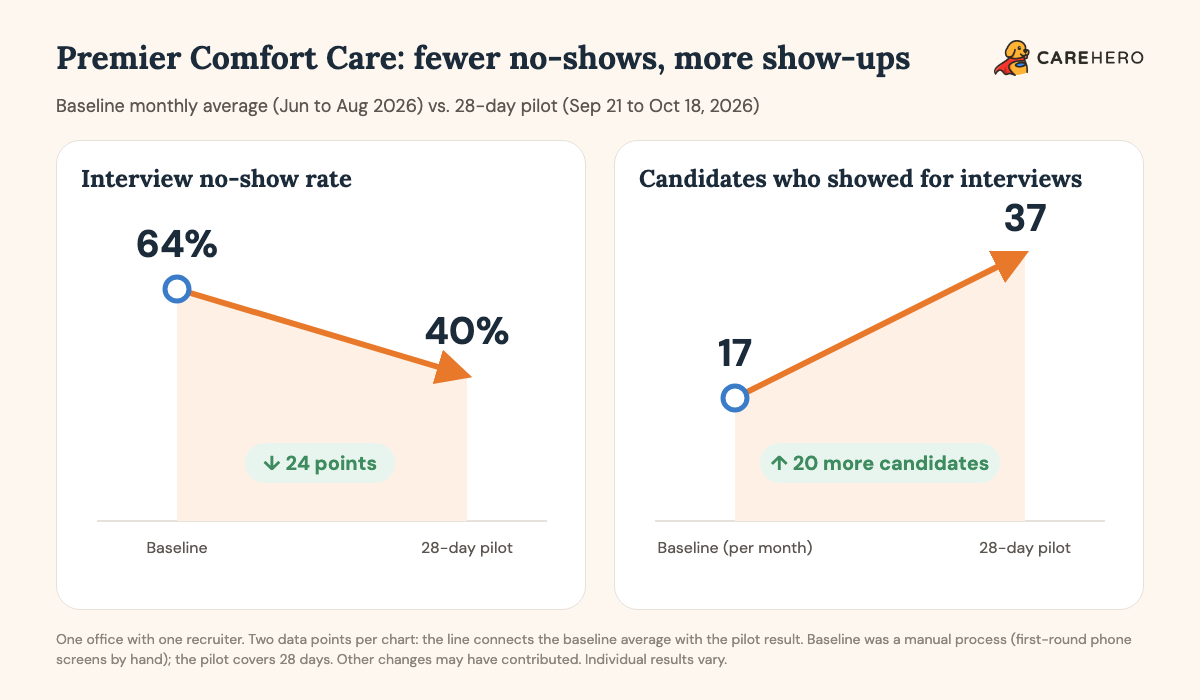
Premier Comfort Care, a California home care office with one recruiter, ran a 28-day Care Hero pilot from September 21 to October 18, 2026. Their baseline was the monthly average from June to August 2026, when first-round phone screens were done by hand and were not tracked. During the pilot:
The office also screened out 53 applicants on its own dealbreakers before they reached the recruiter.
“...it's been a very powerful tool as far as minimizing all the tedious work...”
Mariam added that Care Hero has helped the recruiter streamline a lot of the back and forth, and that having everything on one platform means the office no longer needs Calendly.
Results from one office's 28-day pilot, Sep 21 to Oct 18, 2026, presented in a recap meeting with the office. Baseline: monthly average Jun to Aug 2026, manual process. This is one office over a short period, and other changes may have contributed. Individual results vary. Read the full story.
Does AI phone screening reduce interview no-shows?
It can help, because it shortens the time to first contact and puts a real conversation before the interview. Results depend on the office, and the best proof is your own baseline.
AI phone screening calls each applicant within minutes of applying, day or night, asks your questions, and sends your recruiter the qualified candidates. Applicants who reach the score you set can book their own interview from their phone. Care Hero also sends an SMS reminder before the interview, and reminds applicants to finish their phone interview if they have not. The recruiter keeps what matters most: running the interview and welcoming the caregiver. In the example above, the no-show rate fell during the pilot. We cannot say that any single change caused it, which is why measuring your own before-and-after matters.