Caregivers often apply to several agencies in one sitting, and the first agency to have a real conversation usually gets the interview. This guide covers what makes applicants go quiet, how fast to respond, and how to start contacting them right away, even after hours. It is written by Care Hero, which builds AI phone screening for home care agencies. Care Hero was founded by Jamie Gong, who has worked as a caregiver and knows how much a fast, respectful hiring process matters to caregivers and owners alike.
What makes caregiver applicants go quiet after they apply?
Most go quiet because the agency was slow, the process was unclear, or they found another job while they waited.
- The first call came too late. By the time someone phoned, the applicant had already moved on.
- Nobody answered after hours. Many caregivers apply in the evening or on weekends and expect a reply when they are free.
- Voicemail and phone tag. Missed calls and unanswered messages make a job feel like a hassle.
- An unclear next step. If the applicant does not know what happens after applying, they are more likely to drift away.
- A cold or rushed first contact. A friendly, respectful conversation tells a caregiver how the agency will treat them as an employee.
These are common patterns, not statistics. Your own data will show which one hurts you most.
How fast should a home care agency respond to a caregiver applicant?
As fast as you can, and measured in minutes rather than days. No official benchmark exists, so set your own target and track it.
Speed matters because the applicant is thinking about your job right now. Every hour that passes, they may hear from another agency, take another job, or simply lose interest. A useful target is a first conversation, not just an automated email, soon after the application arrives.
For real response times at five Care Hero clients, from 13 minutes to 1 hour, see how fast you should respond to a caregiver applicant.
How can home care agencies start contacting caregiver applicants right away, even after hours?
Reach out the moment an applicant applies. An AI phone screen that works around the clock lets you reach them right away, without putting your team on call.
Here is how to start contacting applicants immediately:
- Reach out the moment they apply. With Care Hero, each applicant hears from us within minutes and calls in to an AI voice agent whenever it suits them, day or night, in multiple languages. The agent asks your screening questions, and Care Hero sends your team the qualified candidates.
- Do not wait for office hours. Many caregivers apply in the evening or on weekends. Reaching them then, instead of the next morning, keeps them engaged.
- Tell them what happens next. Say when a person will follow up and what the interview involves.
- Follow up if they do not finish. A reminder to complete a phone interview brings back applicants who got interrupted. Care Hero sends one when a phone interview is not completed.
- Let qualified applicants book themselves. When an applicant reaches the phone-interview score you set, Care Hero lets them book their own interview from their phone.
- Keep your recruiter for the human moments. Interviews, welcome calls, and relationships with caregivers stay with your team.
What response times looked like at two Care Hero offices
Two offices that use Care Hero shared their numbers. They differ in size, market, and how they measured, so treat them as two examples, not a benchmark.
Michael's multi-unit Home Instead franchisee agency in Oklahoma and Texas has three offices: Owasso and Vinita in Oklahoma, and Round Rock in Texas. From June 1 to October 17, 2026:

Premier Comfort Care, a California home care office with one recruiter, ran a 28-day pilot from September 21 to October 18, 2026:
During the same 28-day pilot, the interview no-show rate fell from 64% to 40% compared with the June to August monthly average.
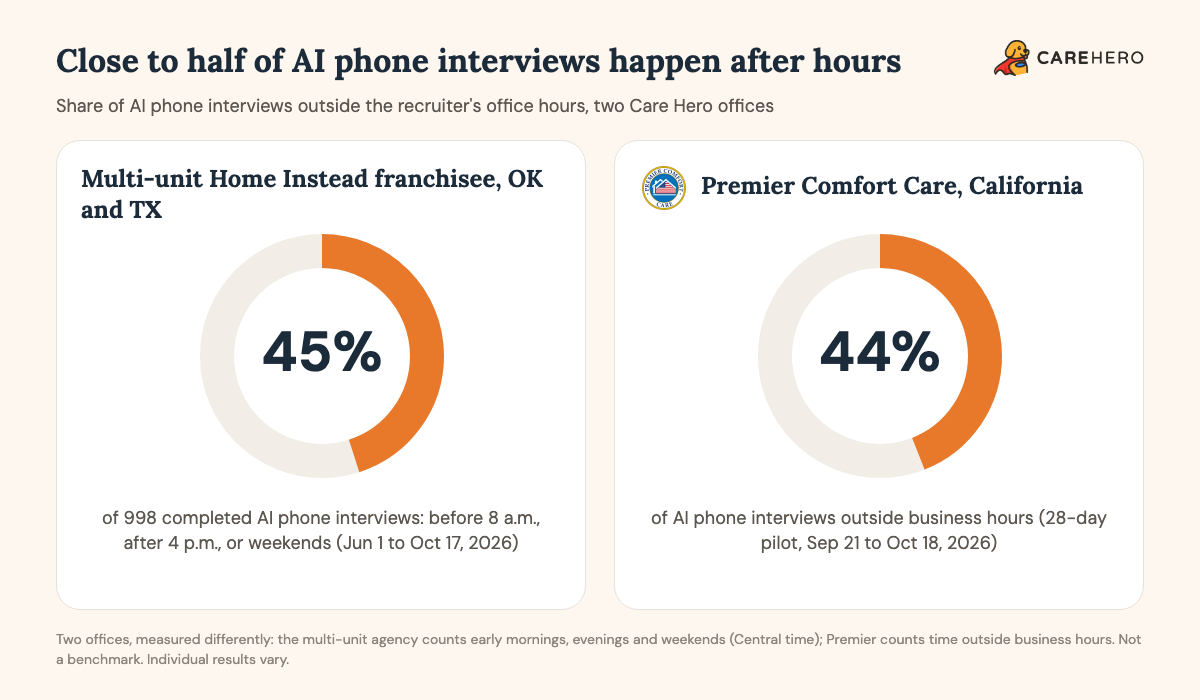
Both offices show how many conversations happen when the recruiter is not at the desk: close to half. Read Michael's story and Premier's story.
Results from two offices. Michael's agency: hires and time to hire from the offices' own records, June 1 to October 28, 2026; screening speed from Care Hero data, June 1 to October 17, 2026; after-hours share from Care Hero data, December 19, 2025 to November 9, 2026. Premier Comfort Care: 28-day pilot, Sep 21 to Oct 18, 2026, against a manual baseline. Time-to-screen figures differ in definition and office; individual results vary.
How should an agency measure its response time?
Track the median time from application to first real conversation, and the share of applicants contacted after hours.
- Median minutes (or hours) from application to first conversation, not just first message
- The share of applicants who never get a conversation
- The share of conversations that happen outside your office hours
- Time from application to interview, and from application to hire
Use the median, not only the average. A few slow cases can pull the average up and hide how a typical applicant is treated.