Most home care recruiters know the feeling: a stack of new applicants, a day of voicemails, and the same first-round questions asked again and again. The screen itself is short. The waiting and the chasing are what take the time. This guide is written by Care Hero, which builds AI phone screening for home care agencies, and it uses three real offices as examples. Care Hero was founded by Jamie Gong, who has worked as a caregiver and knows how much a fast, respectful hiring process matters to caregivers and owners alike.
How can a home care agency screen caregiver applicants faster?
Reach every applicant within minutes, let them take the first-round screen on their own time, and have your recruiter review results instead of dialing.
In practice, that comes down to a few changes:
- Make first contact automatic. Every applicant gets a message the moment they apply, not when someone gets to the list.
- Let the applicant start the screen. With Care Hero, the applicant calls in to a short AI phone interview when it suits them, including evenings and weekends.
- Use your own questions. The first round should check what your office already checks: availability, location, experience, and your dealbreakers.
- Score against your criteria. A consistent score lets the recruiter see quickly who is worth a conversation.
- Hand qualified candidates to a person. The recruiter spends the saved time on interviews and on welcoming new caregivers.
Why does manual phone screening slow caregiver hiring down?
Manual screening depends on the recruiter's free hours, and caregiver applicants are often free at different hours than the office.
- Phone tag. A short screen can take several calls and voicemails before the applicant picks up.
- Office hours only. Someone who applies at night or on a weekend waits until the next business day, and may have accepted another job by then.
- The same questions all day. Recruiters repeat the same first-round questions for every applicant, leaving less time for interviews.
- Notes by hand. Writing down answers while talking makes it easy to miss details.
For more on the first point, read why caregiver applicants stop responding.
What does an AI phone interview handle in the first round?
The AI phone interview takes the first-round screen: it asks your questions, records the answers, and scores them so your recruiter can review the results.
With Care Hero, each applicant hears from us within minutes of applying and starts the phone interview by calling in, 24/7 and in multiple languages. The AI asks the office's own questions and sends your team the qualified candidates with a summary and recording. Here is how that compares with screening by hand:
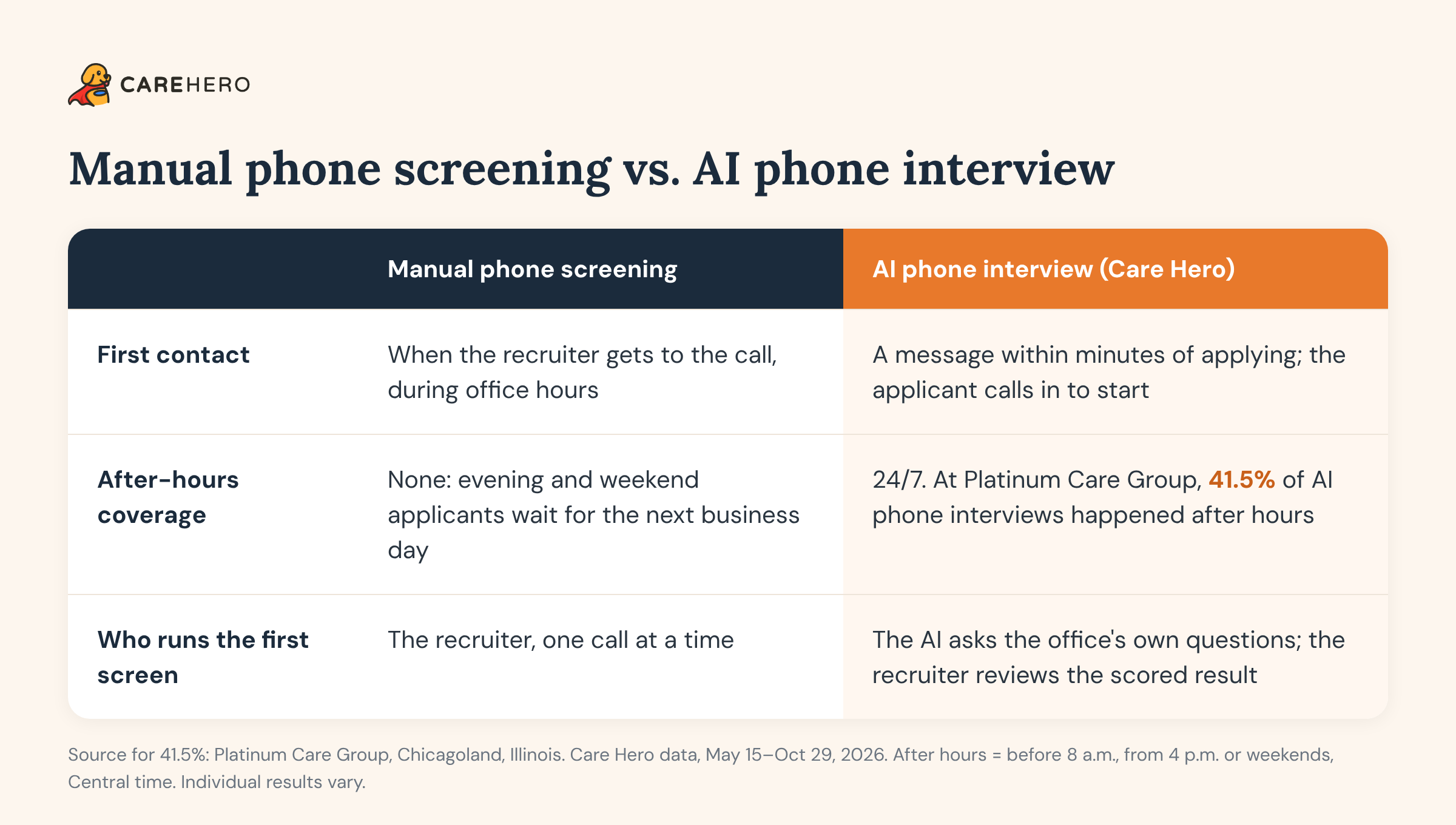
Faster screening also helps later steps. When applicants finish the first round while they are still interested, fewer of them drop out before the interview. See how to reduce caregiver interview no-shows.
How much recruiter time does faster screening give back?
At two offices, about 20 hours of recruiter time a week. A third office's recruiter no longer runs first-round screens at all.
Platinum Care Group, Chicagoland, IL

Before Care Hero, Platinum's recruiter estimated spending 25–30 hours a week on phone screening (May 2026). Vice President Johnny Mako says the office now gets 20 recruiter hours back every week (2026 video interview). Care Hero ran 521 AI phone interviews for the office from May 15 to October 29, 2026.
“It's been really good at capturing information that caregivers say during screening. I can focus more on capturing information during the interview.”
HomeWell Care Services, Lee and Collier counties, FL

At its seven-week review in March 2026, the office estimated about 20 hours a week of recruiter time back. Three weeks after go-live, the recruiter rated the time freed up 10 out of 10 (Feb 2026). Care Hero ran 327 AI interviews for the office from January 20 to October 29, 2026.
Impact Home Health, Kansas

Impact hires across Kansas with one recruiter. Care Hero ran 895 AI phone interviews from April 2 to October 29, 2026: every first-round screen since April, none run by the recruiter.
Recruiter time: Platinum Care Group's Vice President (2026 video interview) and recruiter's own estimate (May 2026); HomeWell Care Services' recruiter estimate (Feb 20, 2026) and 7-week review (Mar 12, 2026). AI interview counts: Care Hero data for each office, periods as stated. Individual results vary.
Which AI caregiver recruiting software reduces recruiter phone screening workload most?
The tools that help most take over the whole first-round screen, at any hour, using your own questions, and give the recruiter a scored result to review.
Before you choose a tool, ask each vendor these questions:
- Who runs the first screen? A voice interview, a text survey, or a scheduling link each leave different work for the recruiter.
- How fast is first contact? Ask how soon an applicant hears from the system after applying.
- Does it work after hours? Ask what share of screens customers complete in the evening and on weekends.
- Whose questions does it ask? It should use your office's criteria and dealbreakers, not a generic script.
- What does the recruiter get? Look for a score, a summary, and a recording, not only a transcript.
- Does it fit your job boards and ATS? Check how it connects to Indeed and the system you already use.
- Can they show real numbers? Ask for customer results with the period and the source, like the ones above.
Features change often, so confirm details in a demo. The goal is the same for every tool: give your recruiter their time back for the human part of hiring.